
Losing hair can feel like a guessing game. Is it just a high hairline, or is it starting to go? That’s where the Norwood Scale comes in. Think of it as the universal “map” that helps you and your doctor figure out exactly where you stand in the journey of male pattern baldness.
GLOJAS Specialist Clinic Indonesia offers expert hair restoration, accurately determining your Norwood Scale stage to provide personalized graft calculations and natural, high-density results for every patient.
What Is the Norwood Scale?
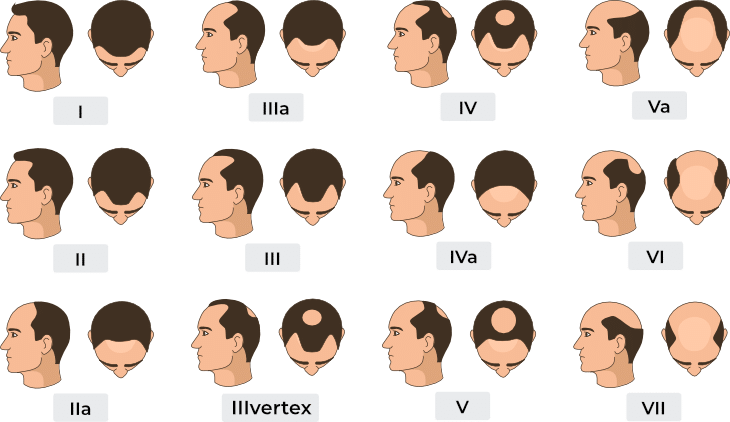
If you’ve ever looked up hair loss online, you’ve probably seen those black-and-white drawings of receding hairlines. That’s the Norwood Scale.
Definition and Purpose of the Norwood Scale
The Norwood Scale (or Hamilton-Norwood Scale) is the leading classification system used to measure the stages of male pattern baldness. It provides a shared language for patients and specialists to discuss how far hair loss has progressed and what the next steps should be.
History and Development of the Norwood Hair Loss Scale
It started with Dr. James Hamilton in the 1950s and was later updated by Dr. O’Tar Norwood in the 1970s. Their research created the gold standard for clinical hair loss assessment that we still use today.
Why the Norwood Scale Is Important for Hair Loss Assessment
Without a scale, “I’m losing hair” is too vague. The Norwood Scale brings data to the conversation.
Role of the Norwood Scale in Diagnosing Male Pattern Baldness
It helps differentiate between temporary shedding and androgenetic alopecia, which is the genetic cause behind most male hair loss.
How Doctors and Hair Specialists Use the Norwood Scale
Specialists use it to track how well a treatment is working. If you start at Stage 3 and stay there for five years while on medication, your treatment is considered a success!
Overview of Norwood Scale Stages
Let’s break down the seven main stages so you can spot where you might fall.
Norwood Stage 1 – Minimal or No Hair Loss
The “control” stage. You have a full head of hair with no significant recession or thinning.
Norwood Stage 2 – Early Hairline Recession
Often called a “mature hairline.” There’s a slight recession around the temples, usually in an M, U, or V shape.
Norwood Stage 3 – Noticeable Hairline and Temple Recession
This is the first stage that clinicians consider “clinically bald.” The recession at the temples becomes deep and symmetrical.
Norwood Stage 3 Vertex – Early Crown Thinning
The hairline might not look too bad, but a bald spot is starting to peek through at the very top (the vertex) of the head.
Norwood Stage 4 – Advanced Frontal and Crown Hair Loss
The recession at the front is deeper, and the bald spot at the back is larger. There is still a distinct band of hair separating the two areas.
Norwood Stage 5 – Enlarged Bald Areas
That band of hair across the top is getting very thin and sparse. The “bridge” between the front and back is breaking down.
Norwood Stage 6 – Extensive Hair Loss with Thin Bridge
The bridge of hair is gone. The front and back bald areas have merged into one large space, though some hair remains on the sides.
Norwood Stage 7 – Severe Hair Loss with Remaining Side Hair
The most advanced stage. Only a thin “horseshoe” of hair remains around the back and sides of the head.
Norwood Scale Diagram and Visual Explanation
Visualizing these stages helps take the anxiety out of the assessment.
How to Read a Norwood Scale Chart
Look at the profile view for hairline depth and the top-down view for crown thinning. Matching both is key to an accurate diagnosis.
Common Misinterpretations of Norwood Scale Images
Many people panic at Stage 2. Remember, a “mature hairline” is a natural part of aging for most men and doesn’t always lead to Stage 7.
How to Determine Your Norwood Scale Stage
Self-Assessment vs Professional Hair Loss Evaluation
You can use a mirror and a photo, but a professional uses a trichoscope to see miniaturized hairs that you might miss.
Key Signs to Look for at Each Norwood Stage
Stage 2: Check your temples against old photos.
Stage 3: Look for the “M” shape.
Stage 4+: Use a hand mirror to check your crown under bright light.
Norwood Scale vs Other Hair Loss Scales
Norwood Scale vs Ludwig Scale
While Norwood is for men, the Ludwig Scale is used to track female pattern hair loss, which usually involves diffuse thinning rather than a receding hairline.
Norwood Scale vs Hamilton Scale
The Hamilton scale was the original version; the Norwood scale is simply the refined, more modern version we use now.
When Each Hair Loss Scale Is Used
Norwood is the industry standard for surgical planning, while other scales might be used in specialized research settings.
Can the Norwood Scale Change Over Time?
Progression of Male Pattern Baldness
Hair loss is usually progressive. Without intervention, most men will move “up” the scale, though the speed varies wildly from person to person.
Factors That Affect Hair Loss Progression
Genetics is the big one, but stress, diet, and hormonal changes play a huge role in how fast you move from a Stage 2 to a Stage 4.
Treatment Options Based on Norwood Scale Stages
Early-Stage Treatments (Norwood 1–2)
Preventative measures like Minoxidil or Finasteride are most effective here to keep what you have.
Moderate Hair Loss Treatments (Norwood 3–4)
This is the “sweet spot” for hair transplants. You still have plenty of donor hair to fill in the receding areas.
Advanced Hair Loss Solutions (Norwood 5–7)
Transplants are still possible, but expectations must be managed. You might need to look into Scalp Micropigmentation (SMP) to create the illusion of density.
Norwood Scale and Hair Transplant Planning
Hair Transplant Eligibility by Norwood Stage
Stage 3 is usually when surgeons start recommending transplants. If you’re Stage 1 or 2, a good surgeon might tell you to wait.
Donor Area Assessment and Long-Term Planning
A Stage 6 patient has less “stable” donor hair than a Stage 3. Doctors must plan so you don’t run out of hair for future procedures.
Limitations of the Norwood Scale
Hair Density, Diffuse Thinning, and Unclassified Patterns
Some men thin everywhere at once (diffuse thinning) without the hairline receding. The Norwood Scale isn’t great at catching this “Type A” variation.
Why the Norwood Scale Is Not a Treatment Predictor
Being Stage 3 doesn’t guarantee a specific result. Your hair follicle health and scalp laxity matter just as much as the stage.
Frequently Asked Questions About the Norwood Scale
Is the Norwood Scale Only for Men?
Yes, primarily. Women’s hair loss follows different patterns, usually tracked by the Ludwig Scale.
Can the Norwood Scale Predict Future Hair Loss?
It shows the pathway, but not the speed. A DNA test or family history is better for predicting how fast it will happen.
At What Norwood Stage Should I Consider Treatment?
The moment it starts bothering you. Usually, Stage 2 or 3 is the best time to start medical or surgical intervention for the best long-term results.